
Polarizer Selection Guide
For more information on polarization read Introduction to Polarization.
Polarization is an important characteristic of light. Polarizers are key optical elements for controlling your polarization, transmitting a desired polarization state while reflecting, absorbing or deviating the rest. There is a wide variety of polarizer designs, each with its own advantages and disadvantages. To help you select the best polarizer for your application, we will discuss polarizer specifications as well as the different classes of polarizer designs to help you select the best polarizer for your application.
Polarizer Characteristics
Polarizers are defined by a few key parameters, some of which are specific to polarization optics. The most important characteristics are:
Extinction ratio: the ratio of transmission of the desired polarization to transmission of the undesired polarization. Also called contrast ratio, it is typically given normalized to the undesired polarization. The higher this value the purer the transmitted polarization; values can range from 100:1 for economical sheet polarizers to over 106:1 for high quality birefringent polarizers. The extinction ratio is a wavelength dependent property and you should be sure to verify the extinction ratio at your application’s wavelength. Removing glare does not require a high extinction ratio, analyzing low concentrations of pharmaceutical compounds on the other hand requires a very high extinction ratio.

Transmission: This value either refers to the transmission of light polarized linearly in the direction of polarization axis, or to the transmission of unpolarized light through the polarizer. Parallel transmission is the transmission of unpolarized light through two polarizers with their polarization axes aligned in parallel, while crossed transmission is the transmission of unpolarized light through two polarizers with their polarization axes crossed. For ideal polarizers transmission of linearly polarized light parallel to the polarization axis is , parallel transmission is 50% and crossed transmission is 0%. This can be calculated with Malus’ law as described in Introduction to Polarization.
Acceptance angle: The acceptance angle is the largest deviation from design incidence angle at which the polarizer will still perform within specifications. Most polarizers are designed to work at an incidence angle of 0° or 45°, or at Brewster’s angle. The acceptance angle is important for alignment but has particular importance when working with non-collimated beams. Wire grid and dichroic polarizers have the largest acceptance angles, up to a full acceptance angle of almost 90°.
Construction: Polarizers come in many forms and designs. Thin film polarizers are thin films similar to optical filters. Polarizing plate beamsplitters are thin, flat plates placed at an angle to the beam. Polarizing cube beamsplitters consist of two right angle prisms mounted together at the hypothenus. Birefringent polarizers consist of two crystalline prisms mounted together, where the angle of the prisms is determined by the specific polarizer design.
Clear aperture: the clear aperture is typically most restrictive for birefringent polarizers as the availability of optically pure crystals limits the size of these polarizers. Dichroic polarizers have the largest available clear apertures as their fabrication lends itself to larger sizes.
Optical path length: the length light must travel through the polarizer. Important for dispersion, damage thresholds and space constraints, optical path lengths can be significant in birefringent polarizers but are usually short in dichroic polarizers.
Damage threshold: the laser damage threshold is determined by the material used as well as the polarizer design, with birefringent polarizers typically having the highest damage threshold. Cement is often the most susceptible element to laser damage, which is why optically contacted beamsplitters or air spaced birefringent polarizers have higher damage thresholds.
Cost: Some polarizers require large, very pure crystals, which are expensive, while others are made of stretched plastic, which make them more economical.
Selection Guide: Reflective Polarizers
Reflective polarizers transmit the desired polarization and reflect the rest. They either use a wire grid, Brewster’s angle or interference effects. Brewster’s angle is the angle at which, based on the Fresnel equations, only s-polarized light is reflected. Because the p-polarized light is not reflected while the s-polarized light is partially reflected, the transmitted light is enriched in p-polarization.
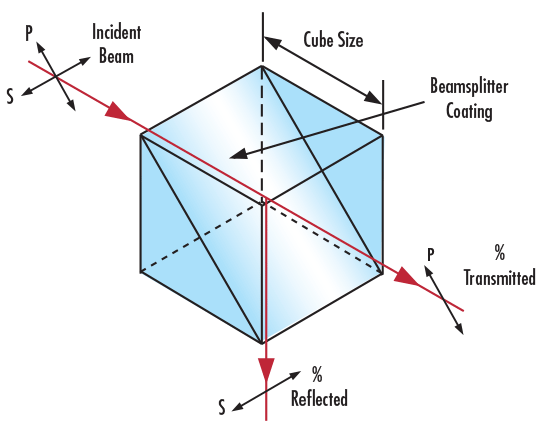
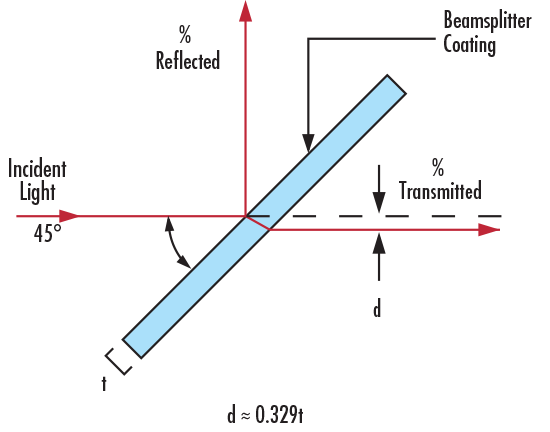
Figure 1: Reflective polarizers, available as cube beamsplitters, plate beamsplitters or thin films, reflect the unwanted polarization state
Type | Applications | Wavelength Range (nm) | Laser Damage Threshold | Cost |
|---|---|---|---|---|
Brewster Windows | Laser Cavities | 200 - 2200 | High | $ |
Polarizing Plate Beamsplitters | Space/Weight Constrained Applications, Low Cost & Low Extinction Ratio Applications, Femtosecond Laser Applications | 250 - 1550 | Low to High | $ |
Polarizing Cube Beamsplitters | Beam Combining | 400 - 1100 | Low to High | $$ |
Wire Grid Polarizers | Demanding Environments, Broadband Applications, Infrared, Uncollimated Light | 300 - 15000 | Low to High | $$ - $$$ |
Wire Grid Polarizing Cube Beamsplitters | Broadband Applications, Uncollimated Light | 400 - 700 | Low to High | $$ |
Brewster Windows
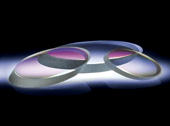
Brewster’s windows are uncoated windows that are placed at Brewster’s angle. A single Brewster’s window has a relatively poor extinction ratio. While this extinction ratio is sufficient for many laser cavity applications due to the many round trips in this cavity, for other applications it can be enhanced by placing multiple Brewster windows in succession (also called a pile of plates). Due to the dependence on the Fresnel equations the acceptance angle is very small for Brewster’s windows, limiting their use to tightly collimated beams.
Specifications | |
Bandwidth (nm) | > 1000 |
Extinction Ratio | 101 - 102 |
Transmission | > 85% |
Acceptance Angle (°) | < 2 |
Clear Aperture | 9 - 23 |
Optical Path Length (mm) | 2 |
Transmitted Wavefront Quality | λ/10 |
Polarizing Plate Beamsplitters
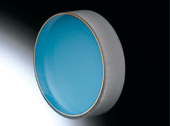
Polarizing plate beamsplitters are coated windows, placed at an angle, that transmit p-polarization and reflect s-polarization. The coating on the plate generally works in either interference or internal Brewster’s angle principles. In contrast to many birefringent polarizers, both the reflected and transmitted beams are usable. These beamsplitters are useful in weight or space constrained applications and where laser damage threshold and a short optical path length are important. A disadvantage is the appearance of ghost reflections from the second surface and beam deviation. These also exist in ultrafast versions which are ideal for femtosecond pulsed lasers.
Specifications | |
Bandwidth (nm) | 10 to 400 |
Extinction Ratio | 102 - 104 |
Transmission | > 85% |
Acceptance Angle (°) | 2 - 4 |
Clear Aperture | 11 - 45 |
Optical Path Length (mm) | 1 |
Transmitted Wavefront Quality | λ/8 - λ/2 |
Polarizing Cube Beamsplitters
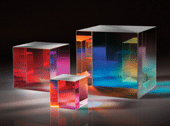
Polarizing cube beamsplitters are similar to polarizing plate beamsplitters, but the coating is placed in between two right angle prisms. Mounting and aligning polarizing cube beamsplitters is easier than plate beamsplitters and there is less beam deviation, but they have a longer optical path length, take up more space and weigh more. They are ideal for collimated light sources and are more efficient than wire grid polarizing cube beamsplitters. Non-polarizing cube beamsplitters exist as well, for more information on these please read What are Beamsplitters?.
Specifications | |
Bandwidth (nm) | 10 to 400 |
Extinction Ratio | 102 - 103 |
Transmission | > 95% |
Acceptance Angle (°) | 4 - 10 |
Clear Aperture | 4 - 45 |
Optical Path Length (mm) | 5 - 50 |
Transmitted Wavefront Quality | λ/4 |
Wire Grid Polarizers
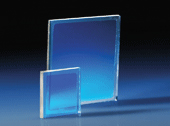
Wire grid polarizers consist of many thin wires arranged parallel to each other. Light that is polarized along the direction of these wires is reflected, while light that is polarized perpendicular to these wires is transmitted. Because the principle of parallel wires is wavelength independent, wire grid polarizers cover a very large wavelength range well into the IR, limited by material or AR coating absorption. This design is very robust, with excellent environmental stability and a large acceptance angle. While most wire grid polarizers use glass substrates, thin film wire grid polarizers offer a more economical solution.
Specifications | |
Bandwidth (nm) | 300 to > 5000 |
Extinction Ratio | 102 - 104 |
Transmission | > 50% to > 75% |
Acceptance Angle (°) | 40 |
Clear Aperture | 13 - 44 |
Optical Path Length (mm) | 1 - 2 |
Transmitted Wavefront Quality | λ/4 - λ/2 |
Wire Grid Polarizing Cube Beamsplitters
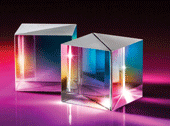
Wire Grid Polarizing Cube Beamsplitters are polarizing cube beamsplitters that use a wire grid polarizer in between the hypotenuses of the two prisms. These polarizers combine the easy alignment of polarizing cube beamsplitters with the large angle acceptance and environmental stability of wire grid polarizers.
Specifications | |
Bandwidth (nm) | 300 |
Extinction Ratio | 103 - 104 |
Transmission | > 75% |
Acceptance Angle (°) | 50 |
Clear Aperture | 23 |
Optical Path Length (mm) | 25 |
Transmitted Wavefront Quality | λ/4 - λ/2 |
Selection Guide: Dichroic Polarizers
Dichroic polarizers transmit the desired polarization and absorb the rest. This is achieved via anisotropy in the polarizer; common examples are oriented polymer molecules and stretched nanoparticles. This is a broad class of polarizers, going from low cost laminated plastic polarizers to precision high cost glass nanoparticle polarizers. Most dichroic polarizers have good extinction ratios relative to their cost. Their damage thresholds and environmental stability are often limited, although glass dichroic polarizers outperform plastic dichroic polarizers in this aspect. Dichroic polarizers are well suited for microscopy, imaging and display applications, and are often the only choice when very large apertures are necessary.
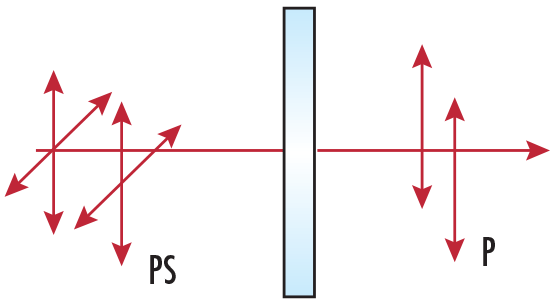
Figure 2: Dichroic polarizers absorb the unwanted polarization state
Type | Applications | Wavelength Range (nm) | Laser Damage Threshold | Cost |
|---|---|---|---|---|
Dichroic | Microscopy, Display, Imaging, Intensity Adjustment | 300 - 2700 | Low to Medium | $ - $$$ |
Specifications | |
|---|---|
Bandwidth (nm) | 100 to > 1000 |
Extinction Ratio | 102 - 106 |
Transmission | > 50% to > 90% |
Acceptance Angle (°) | 40 - 80 |
Clear Aperture | 10 - 900 |
Optical Path Length (mm) | 0.2 - 2 |
Transmitted Wavefront Quality | λ/5 - λ/2 |
Selection Guide: Birefringent Polarizers
Birefringent polarizers transmit the desired polarization and deviate the rest. They rely on birefringent crystals, where the refractive index of light depends on its polarization. Unpolarized light at non-normal incidence will split into two separate beams upon entering the crystal, as the refraction for s- and p-polarized light will be different. Most designs consist of two joined birefringent prisms, where the angle they are joined at and the relative orientation of their optical axes determine the functionality of the polarizer. Because these polarizers require optically pure crystals they are expensive, but have high laser damage thresholds, excellent extinction ratios and broad wavelength ranges.
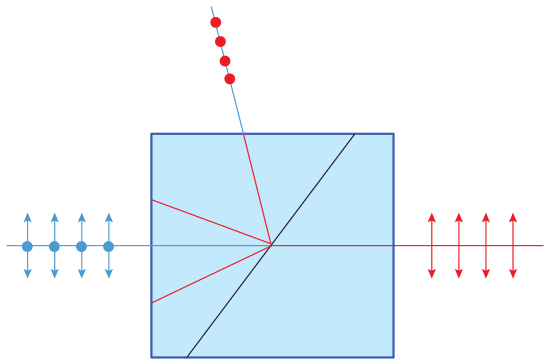
Figure 3: Cystalline polarizers, such as the Glan-Taylor polarizer, transmit a desired polarization and deviate the rest, using birefringent properties of their crystalline materials
Type | Applications | Wavelength Range (nm) | Laser Damage Threshold | Cost |
|---|---|---|---|---|
Glan-Thompson | Laser Applications, High Quality Imaging and Microscopy | 220 - 2200 | Medium | $$$ |
Glan-Taylor | Laser Applications, Spectroscopy | 220 - 2200 | High | $$$ |
Glan-Laser | Laser Applications, Q-Switching Lasers | 220 - 2200 | Very High | $$$ |
Wollaston Prisms | Laboratory Experiments, where both polarizations need to be accessed | 190 - 4000 | High | $$$ |
Rochon Prisms | Laboratory Experiments, where both polarizations need to be accessed | 130 - 7000 | High | $$$ |
Glan-Thompson Polarizers
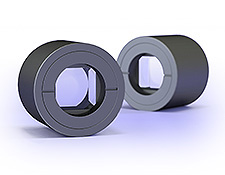
Glan-Thompson polarizers have the largest acceptance angle of the Glan-type polarizers. Cement is used to join the prisms together, which causes a low optical damage threshold.
Specifications | |
Bandwidth (nm) | > 1000 |
Extinction Ratio | 105 - 107 |
Transmission | > 85% |
Acceptance Angle (°) | 15 - 30 |
Clear Aperture | 8 - 13 |
Optical Path Length (mm) | 28 - 40 |
Transmitted Wavefront Quality | λ/4 |
Glan-Taylor Polarizers
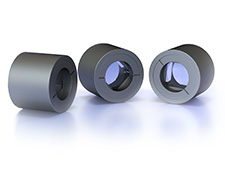
Glan-Taylor polarizers have a higher optical damage threshold than Glan-Thompson due to an air gap instead of cement in between the two constituent prisms. They have a shorter optical path length but also a smaller acceptance angle than Glan-Thompson polarizers.
Specifications | |
Bandwidth (nm) | > 1000 |
Extinction Ratio | 105 - 107 |
Transmission | > 85% |
Acceptance Angle (°) | 6 |
Clear Aperture | 8 - 20 |
Optical Path Length (mm) | 17 - 29 |
Transmitted Wavefront Quality | λ/4 |
Glan-Laser Polarizers
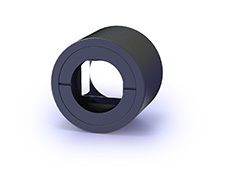
Glan-Laser polarizers are special versions of Glan-Taylor polarizers with a high laser damage threshold. These typically have higher quality crystals, better polished surfaces and the rejected beam is allowed to escape via escape windows, decreasing unwanted internal reflections and thermal damage due to the absorption of the rejected beam.
Specifications | |
Bandwidth (nm) | > 1000 |
Extinction Ratio | 105 - 107 |
Transmission | > 85% |
Acceptance Angle (°) | 6 |
Clear Aperture | 8 - 20 |
Optical Path Length (mm) | 20 - 38 |
Transmitted Wavefront Quality | λ/8 - λ/4 |
Wollaston Prisms
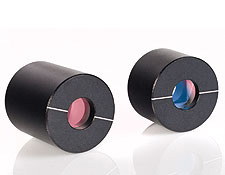
Wollaston prisms are birefringent polarizers that are designed to transmit but separate both polarizations. In contrast with the Glan-type polarizers, both beams are compley polarized and usable. The orthogonally polarized beams exit the polarizer symmetrically at a wavelength dependent angle from the incident beam.
Specifications | |
Bandwidth (nm) | > 1000 |
Extinction Ratio | 104 - 106 |
Transmission | > 85% |
Acceptance Angle (°) | 20 |
Clear Aperture | 10 |
Optical Path Length (mm) | 18 - 28 |
Transmitted Wavefront Quality | λ/4 |
Rochon Prisms
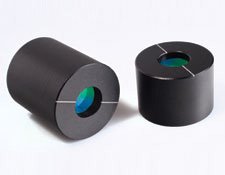
Rochon prisms are similar to Wollaston prisms in that both beams are transmitted, but in this polarizer one beam is transmitted undeviated while the other is transmitted at wavelength dependent angle.
Specifications | |
Bandwidth (nm) | > 1000 |
Extinction Ratio | 104 - 106 |
Transmission | > 85% |
Acceptance Angle (°) | 20 |
Clear Aperture | 10 |
Optical Path Length (mm) | 16 - 28 |
Transmitted Wavefront Quality | λ/4 |
Finally, circular polarizers also exist. These are not a separate type of polarizer, as they are the combination of a linear polarizer with a correctly aligned quarter waveplate. The polarizer linearly polarizers the incident light, and the quarter waveplate at 45° turns this linearly polarized light into circularly polarized light. The advantage is that the polarizer and waveplate axes are always aligned correctly relative to each other so no alignment is necessary and there is no concern of generating elliptically polarized light.
版權所有 © 2025 江陰韻翔光電技術有限公司 備案號:蘇ICP備16003332號-1 技術支持:化工儀器網 管理登陸 GoogleSitemap


